QIN-HEADNECK | QIN-HEADNECK
DOI: 10.7937/K9/TCIA.2015.K0F5CGLI | Page Accessibility: Public | Collection
| Location | Species | Subjects | Data Types | Cancer Types | Size | Status | Updated | |
|---|---|---|---|---|---|---|---|---|
| Head-Neck | Human | 279 | PT, CT, SR, SEG, RWV | Head and Neck Carcinomas | Clinical, Image Analyses | Public, Complete | 2023/09/13 |
Data Access
Summary
: U24 CA180918 (http://qiicr.org) and U01 CA140206.
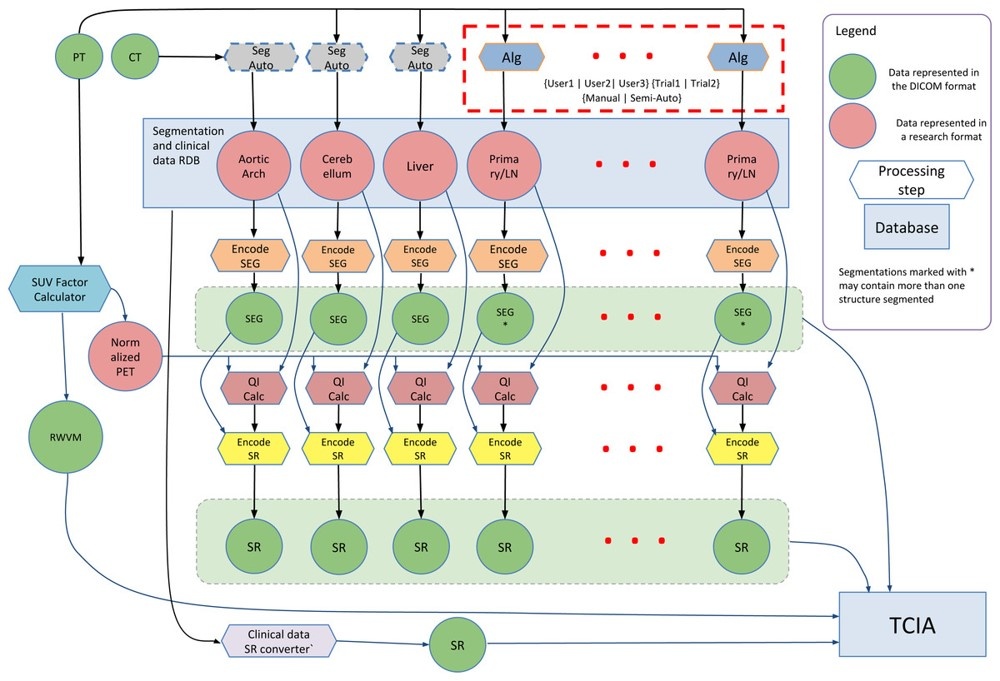
The following schematic summarizes much of the work done within the QIICR grant to augment the PET/CT scans with segmentations and clinical data using the DICOM standard: (click to enlarge)
The mission of the QIN is to improve the role of quantitative imaging for clinical decision making in oncology by developing and validating data acquisition, analysis methods, and tools to tailor treatment for individual patients and predict or monitor the response to drug or radiation therapy. More information is available on the Quantitative Imaging Network Collections page. Interested investigators can apply to the QIN at: Quantitative Imaging for Evaluation of Responses to Cancer Therapies (U01) PAR-11-150.
| Title | Data Type | Format | Access Points | License | |||
|---|---|---|---|---|---|---|---|
| Images and Segmentations | SR, CT, SEG, RWV, PT | DICOM | Requires NBIA Data Retriever |
1,032 | 3,837 | 701,002 | TCIA Restricted |
| Clinical Data (See also Detailed Description) | XLSX | CC BY 3.0 |
Detailed Description
Associated Clinical Metadata
- Structured Report DICOM objects (Modality SR), are available for a subset of these subjects in the DICOM downloads and can be distinguished from image files by the series description “Clinical Data.” Note, there is no image preview thumbnail for a Structured Report.
Citations & Data Usage Policy
Data Citation |
|
|
Beichel, R. R., Ulrich, E. J., Bauer, C., Wahle, A., Brown, B., Chang, T., Plichta, K., Smith, B., Sunderland, J., Braun, T., Fedorov, A., Clunie, D., Onken, M., Magnotta, V. A., Menda, Y., Riesmeier, J., Pieper, S., Kikinis, R., Graham, M.M., Casavant T. L., Sonka M,. & Buatti, J. (2015). Data From QIN-HEADNECK (Version 4) [Data set]. The Cancer Imaging Archive. https://doi.org/10.7937/K9/TCIA.2015.K0F5CGLI |
Publication Citation |
|
|
Fedorov, A., Clunie, D., Ulrich, E., Bauer, C., Wahle, A., Brown, B., Onken, M., Riesmeier, J., Pieper, S., Kikinis, R., Buatti, J., & Beichel, R. R. (2016). DICOM for quantitative imaging biomarker development: a standards based approach to sharing clinical data and structured PET/CT analysis results in head and neck cancer research. In PeerJ (Vol. 4, p. e2057). PeerJ. https://doi.org/10.7717/peerj.2057 |
TCIA Citation |
|
|
Clark, K., Vendt, B., Smith, K., Freymann, J., Kirby, J., Koppel, P., Moore, S., Phillips, S., Maffitt, D., Pringle, M., Tarbox, L., & Prior, F. (2013). The Cancer Imaging Archive (TCIA): Maintaining and Operating a Public Information Repository. In Journal of Digital Imaging (Vol. 26, Issue 6, pp. 1045–1057). Springer Science and Business Media LLC. https://doi.org/10.1007/s10278-013-9622-7 |
Other Publications Using This Data
TCIA maintains a list of publications which leverage TCIA data. If you have a manuscript you’d like to add please contact TCIA’s Helpdesk.
- Ahmadvand, P., Duggan, N., Bénard, F., & Hamarneh, G. (2016). Tumor Lesion Segmentation from 3D PET Using a Machine Learning Driven Active Surface. International Workshop on Machine Learning in Medical Imaging. doi: 10.1007/978-3-319-47157-0_33
- Fedorov, A., Beichel, R., Kalpathy-Cramer, J., Clunie, D., Onken, M., Riesmeier, J., . . . Kikinis, R. (2020). Quantitative Imaging Informatics for Cancer Research. JCO Clin Cancer Inform, 4, 444-453. doi:https://doi.org/10.1200/CCI.19.00165
- Fedorov, A., Clunie, D., Ulrich, E., Bauer, C., Wahle, A., Brown, B., . . . Beichel, R. R. (2016). DICOM for quantitative imaging biomarker development: a standards based approach to sharing clinical data and structured PET/CT analysis results in head and neck cancer research. PeerJ, 4, e2057. doi: 10.7717/peerj.2057
- Ghattas, A. E. (2017). Medical Imaging Segmentation Assessment via Bayesian Approaches to Fusion, Accuracy and Variability Estimation with Application to Head and Neck Cancer. (PhD). The University of Iowa, Retrieved from http://ir.uiowa.edu/etd/5759
- Liang, X., Bassenne, M., Hristov, D. H., Islam, M. T., Zhao, W., Jia, M., . . . Xing, L. (2022). Human-level comparable control volume mapping with a deep unsupervised-learning model for image-guided radiation therapy. Comput Biol Med, 141, 105139. doi: 10.1016/j.compbiomed.2021.105139
- Lv, W., Zhou, Z., Peng, J., Peng, L., Lin, G., Wu, H., . . . Lu, L. (2023). Functional-structural Sub-region Graph Convolutional Network (FSGCN): Application to the Prognosis of Head and Neck Cancer with PET/CT imaging. Computer Methods and Programs in Biomedicine. doi: 10.1016/j.cmpb.2023.107341
- Sinha, A. (2018). Deformable registration using shape statistics with applications in sinus surgery. (Ph. D.). Johns Hopkins University, Retrieved from http://jhir.library.jhu.edu/handle/1774.2/59202
- Sinha, A., Billings, S. D., Reiter, A., Liu, X., Ishii, M., Hager, G. D., & Taylor, R. H. (2019). The deformable most-likely-point paradigm. Medical image analysis, 55, 148-164. doi: 10.1016/j.media.2019.04.013
- Sinha et al. Towards automatic initialization of registration algorithms using simulated endoscopy images. link to article
- Sinha, A., Ishii, M., Hager, G. D., & Taylor, R. H. (2019). Endoscopic navigation in the clinic: registration in the absence of preoperative imaging. Int J Comput Assist Radiol Surg, 14(9), 1495-1506. doi: 10.1007/s11548-019-02005-0
- Smith, B. J., Buatti, J. M., Bauer, C., Ulrich, E. J., Ahmadvand, P., Budzevich, M. M., . . . Beichel, R. R. (2020). Multisite Technical and Clinical Performance Evaluation of Quantitative Imaging Biomarkers from 3D FDG PET Segmentations of Head and Neck Cancer Images. Tomography, 6(2), 65-76. doi: 10.18383/j.tom.2020.00004
- Stoll, M., Stoiber, E. M., Grimm, S., Debus, J., Bendl, R., & Giske, K. (2016). Comparison of Safety Margin Generation Concepts in Image Guided Radiotherapy to Account for Daily Head and Neck Pose Variations. PLoS One, 11(12), e0168916. doi: 10.1371/journal.pone.0168916
- Taghanaki, S. A., Duggan, N., Ma, H., Hou, X., Celler, A., Benard, F., & Hamarneh, G. (2018). Segmentation-free direct tumor volume and metabolic activity estimation from PET scans. Comput Med Imaging Graph, 63, 52-66. doi: 10.1016/j.compmedimag.2017.12.004
- Thomas, R., Schalck, E., Fourure, D., Bonnefoy, A., & Cervera-Marzal, I. (2021). 2Be3-Net: Combining 2D and 3D Convolutional Neural Networks for 3D PET Scans Predictions. Paper presented at the International Conference on Medical Imaging and Computer-Aided Diagnosis (MICAD 2021). doi: 10.1007/978-981-16-3880-0_27
- Trebeschi, S., Bodalal, Z., van Dijk, N., Boellaard, T. N., Apfaltrer, P., Tareco Bucho, T. M., . . . Beets-Tan, R. G. H. (2021). Development of a Prognostic AI-Monitor for Metastatic Urothelial Cancer Patients Receiving Immunotherapy. Front Oncol, 11, 637804. doi: 10.3389/fonc.2021.637804
- Vrtovec, T., Močnik, D., Strojan, P., Pernuš, F., & Ibragimov, B. (2020). Auto‐segmentation of organs at risk for head and neck radiotherapy planning: from atlas‐based to deep learning methods. Medical Physics, 47, e929-e950. doi: 10.1002/mp.14320
- Zschaeck, S., Li, Y., Lin, Q., Beck, M., Amthauer, H., Bauersachs, L., . . . Hofheinz, F. (2020). Prognostic value of baseline [18F]-fluorodeoxyglucose positron emission tomography parameters MTV, TLG and asphericity in an international multicenter cohort of nasopharyngeal carcinoma patients. PLoS One, 15(7), e0236841. doi: 10.1371/journal.pone.0236841